
Pop ads earn well, but browsers don't always let them through. Chrome and other browsers block pop-ups in many situations, and many publishers prefer not to show pops to certain browsers at all. Every blocked pop is a lost impression. GoAdserver's blocked-browser fallback solves this: on a pop ad zone you list the browsers that should not get a pop, and visitors on those browsers get a full-page ad (FPA) instead, so the impression still earns.
How it works
- Blocked browsers. On the pop ad zone you choose the browsers where the pop should not run, for example Chrome.
- Full-page fallback. You connect a full-page interstitial ad zone as the alternative.
- Automatic switch. Visitors on allowed browsers get the pop as usual; visitors on a blocked browser get the full-page ad instead.
A full-page interstitial shows on top of the page between page views. It is visible, earns like a high-impact format, and doesn't open a new window, so browsers don't block it the way they block pop-ups.
Set it up
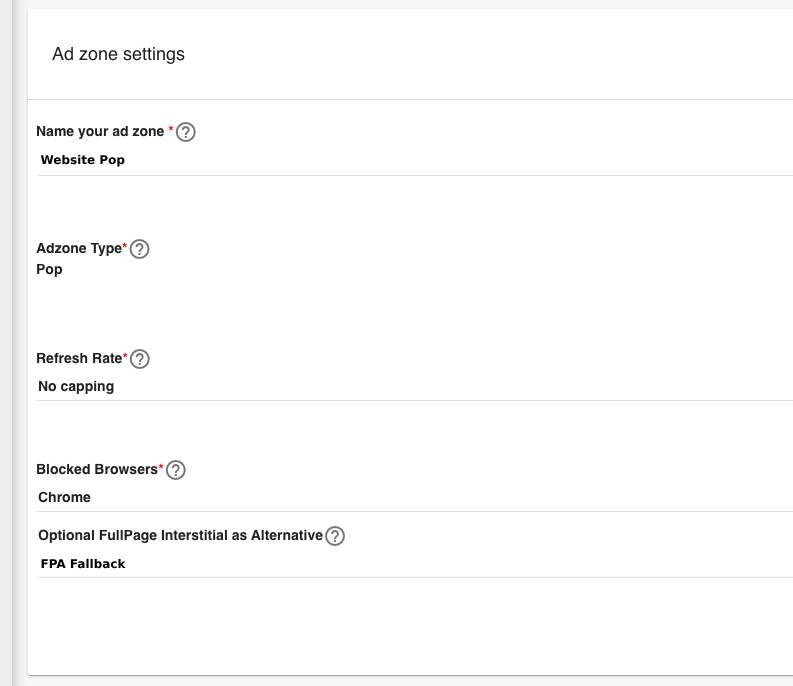
- Create the full-page ad zone first on the same website (type Full Page or a full-page interstitial). It must exist before you can pick it as a fallback.
- Open or create your pop ad zone (type Pop), give it a name such as "Website pop" and set the refresh or capping you want.
- Blocked browsers: select the browsers that should not get the pop, for example Chrome.
- Full-page fallback zone: in the same Pop Ad Settings, pick the full-page ad zone you created. Only your own full-page zones are listed. Visitors on a blocked browser now get that full-page ad instead of nothing.
- Save and test in an allowed browser and in a blocked one, and check both zones in your statistics.
Why use it
- Fewer lost impressions: traffic that would have been blocked still earns.
- Better experience: visitors on browsers you'd rather not pop get a full-page ad instead.
- Your choice per zone: decide per pop zone which browsers fall back.
- Ready for browser changes: when a browser tightens its pop-up rules, add it to the list.
More ways to keep pop ads working
The full-page fallback is one of several pop zone settings that help you earn from pops without upsetting browsers or visitors:
- Display type. Choose how the ad opens. Pop-under opens a separate window that tries to go behind your page; current Chrome, Firefox and Safari usually keep it in front, as a pop-up window. Pop-up and tab-up open the ad in a new tab in front of your page. Tab-under reopens your page in a new tab and turns the current tab into the ad. It is not recommended, because Google treats this pattern as deceptive and it can cost you search ranking.
- Trigger method. Let the pop fire anywhere on the page, only on links, only on specific elements, or anywhere except elements you list (for example your video player or menu), using CSS selectors.
- Wait for engaged visitors on Chrome. Hold the pop back on Chrome until the visitor has viewed at least three pages and spent at least three minutes on your site in the same visit.
- Fire on exit. Open the ad when the visitor leaves instead of on a click.
- Capping and filters. Limit how often a visitor sees a pop, and filter by country, browser and device type.
Why browsers block pop ads
Browsers block windows that a page opens without a clear user action, and they act against sites whose ads open unexpectedly or mislead visitors. A pop that fires on a real click, at a sensible frequency, is far less likely to be blocked than one that fires on page load or on every click. The settings above, together with the full-page fallback, let you keep pop revenue while staying on the right side of those rules.
Related
See all ad formats GoAdserver serves, including pop, tabs, full page and interstitial variants, and how SmartZones let several networks compete for the same placement. Publishers can also monetize their websites with display, native, video and push. Every pop zone setting is listed in the pop ad zone reference, and the publisher ad server page shows the rest of the publisher toolkit.